
Butt Wink, Hip Openers and the Pelvic Floor
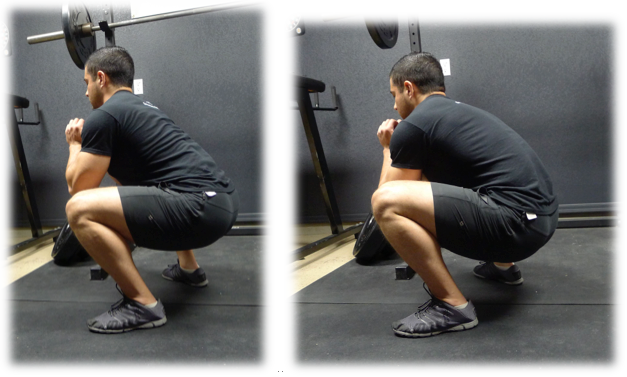
Butt wink is the awesomely named tucking under of the bum at the bottom of a squat (loaded and unloaded). Some great blogs on the subject include a great review of the anatomical/structural contributions to the issue by Ann Wendel for Girl Gone Strong. Dean Somerset had a great review and ways to delineate the potential sources in order to know how best to treat or correct.
I am a fan of sorting out if something is a motor program first, before assuming structure or restriction in tissues as the primary contributing factors. To that end, I wanted to add one more thought to the conversation, the possible role of the pelvic floor for some butt winkers.
First, let’s talk anatomy and why you should care about the status of the pelvic floor when looking at Butt Wink:
- The pelvic floor is one of the primary stabilizers of the joints of the pelvic ring . In addition, it has relationships with the Diaphragm and the TA that collectively contribute to trunk and pelvic stability. Take away: If local or global trunk and pelvic stability is a piece of the motor control puzzle and butt wink is the compensation, then understanding how your client is or is not recruiting the pelvic floor may be important to add to your thinking.
- The pelvic floor interacts with the obturator internus (one of the deep hip rotators) through the arcuate tendon and can contribute to and influence local control of the hip. Chris Powers, PT describes the role of the deep hip rotators as similar to that of the rotator cuff of the shoulder, they act as stabilizers of the hip while larger more superficial muscles move the joint. So the interaction between the pelvic floor and its teammates (see #1) can have a role in anchoring the deep hip rotators, setting up the action of the larger hip muscles engaged in the squat.
- If you are familiar with and look for Anterior Femoral Glide in a straight leg raise (ala Shirley Sahrmann), try this. Test the SLR, and then retest on exhale with an engagement of the pelvic floor. I find that with those relationships (#2) in place before movement, the femoral head spins in the socket rather than translating anteriorly. Try it!
Take aways:
- The role of the pelvic floor to help create an anchor for the deep stabilizers of the hip is important for optimizing the power of the large hip musculature to both control descent and to create power for ascent in a squat.
- Women may either unknowingly over-recruit their pelvic floors for stability alongside heavy abdominal recruitment, or actively over-recruit to prevent leaks while lifting. Either way they may using the pelvic floor in a shortened way or actively shortening (no muscular margin to meet the demand) at the deepest and most challenging part of the lift which could contribute to the butt winking under.
- Chronic over-recruitment of the pelvic floor in a shortened position, subconsciously or consciously, may not allow the pelvic-hip relationship to open fully at the bottom of the squat. (side note: this might also be happening to your yogi patients who complain of tight hips when they try hip openers at class. Or your runners with chronically tight hips post run)
- Lots of folks wink their butts under well before the bottom of a squat. This is a motor control or muscle recruitment patterning issue that the pelvic floor could play a role in.
So how does a sports med pro screen to understand if the pelvic floor is contributing to the problem?
First, ask. Some conversation starter suggestions: ‘Are you aware of your pelvic floor while you are doing the squat?’ ‘Do you know what the pelvic floor does and why it is important to your squat (see above if you need answers)?’ A great phrase I learned from my friend, Shelley Mannell, is “I’m/We’re on a new learning curve about…..” in this case about the role of the PF in trunk, pelvic, and hip stability. Briefly educate them and see what they are or can become aware of. This may open a conversation with them about leaking while exercising, and their attempts to stop it with over-recruitment, such as “Yep, I do a kegel all the way thru the squat to try not to leak.” Heads-up for you and them, this strategy likely doesn’t work (see here), they leak any way and they restrict pelvic and hip motion in the process.
A study by Smith et al demonstrated that women that were severely incontinent demonstrated the greatest pelvic floor recruitment in a postural challenge, but they also had the greatest recruitment of external obliques. The continent women had the least recruitment of both. The author’s conclusion was to consider the interrelationship between muscles vs isolated engagement of the pelvic floor as a solution for incontinence. The continent women in the study were demonstrating a balanced, efficient, coordinated system. They actually had to work less to pull off continence during a challenge. That is the goal for your client as well, to achieve balance and efficiency again in their continence control system (hint, hint it is the same system for their central stability, see #1). Squeezing one part of the system does not create a balance.
Second, observe. Does you client/patient have a butt wink in their daily life? Are glutes a part of their other movement patterns? If they have no arse at all or often they will have flattened upper bum and junk in the trunk below, they are not utilizing that pelvic-local hip stabilizer-large hip mover relationship well in their day to day. Why would you or they expect it to show up at the bottom of a squat?! Ask your client in upright standing to “tension their core” and prep for movement or a lift and watch their strategy. Does their butt wink under just as a prep? You have to tune them into their pattern for stability in an unchallenged situation, so they understand how to use their body differently when it is under the gun.
Next, try an alternative approach. Teach them to let go/open/lengthen their pelvic floor and inhale on the way down (unloaded first as you train the motor program, and then gradually controlled as you add submax, asymptomatic loads; strategy will change with higher percentage loads and may include breath holding). A great cue is ask them to let their tailbone lift as they inhale on the descent. This will promote a more optimized position of the pelvis (neutral range) for loading and glute support on the way down, all the way down. A neutral pelvic position optimizes the availability of the pelvic floor to participate with the rest of the system and they may find it is easier to control leaks. This is also a great cue for your yogis, allowing the pelvic floor to open and tailbone lift during poses will help to keep the hips open as well. An added bonus will be that they don’t feel “tight” in the hips during or after a set or a pose.
Free up the hips of your butt winkers, runners and yogis. A few simple cues and interventions can rule out or in the pelvic floor as a part of a faulty motor plan.
Want to learn more about treating or training Female Athletes? Check out online courses here.
- Talasz H, Kremser C, Kofler M, Kalchschmid E, Lechleitner M, Rudisch A. Phase-locked parallel movement of diaphragm and pelvic floor during breathing and coughing – a dynamic MRI investigation in healthy females. Int Urogynecol J. 2011;22(1):61–68.
- Powers C, Sahrmann S. The Functions and Dysfunctions of the Hip. California Physical Therapy Association Conference. Los Angeles, California; 2012.
- Smith MD, Coppieters MW , Hodges PW . Postural response of the pelvic floor and abdominal muscles in women with and without incontinence. Neurourol Urodyn. 2007;26(3):377-85.